


The Many Benefits of Marine Conservation
By Claire, Conservation Campaign Manager and Juliana, Social Media and Content Assistant
One of the most ecologically and culturally significant marine regions in Canada is right here, in Western Hudson Bay. Recently, local and international groups have been looking to further develop shipping and trade in the Bay and expansion of Churchill’s port has been championed by provincial and federal governments.
Locally known as Kangiqsualuk ilua, Kischekumee, and Tasiujaqiuaqmiut, this remarkable region is home to more than 60% of Canada’s beluga whales, as well as polar bears, birds, and people. Churchill on the bay’s coast opens its doors every year to tens of thousands of tourists from around the world.
In a region of great change and great possibility, conservation is an important tool. Not just for protecting important habitats, but for the many other benefits to people’s health, wellbeing, and our economy.
Economic Benefit from Conservation
The peer-reviewed report, Widely Enjoyed but Inadequately Valued, outlines just how beneficial protected and conserved areas. This also includes marine protected areas are across Canada. Protected areas create nearly $11 billion in GDP annually, supporting 150,000 jobs and returning $1.4 billion annual tax revenue.
Marine conservation areas are good for the economy
Canada has 53 national parks and National Marine Conservation Areas (NMCA). Marine ecosystems cover 26 per cent of Canada’s national parks systems, at 12.248 million hectares.
We know that greater federal spending in protected and conserved areas is proven to support local economies through tourism. As an example, the Saguenay–St. Lawrence Marine Park generated over $89 million for local business in 2017 alone.


Nature’s worth is infinite, but when you focus primarily on what we can quantify, the economic returns from protected and conserved areas are striking. This report shows that nature is already delivering real, sustained value to Canada’s economy, whether we account for it or not.
– Jason Wong, CPAWS Economic Analyst, lead author Widely Enjoyed but Inadequately Valued
Health & Wellbeing Benefit from Conservation
In Canada, access to parks is proven to reduce stress and anxiety, encourage physical activity, strengthen social connections, and foster healthy family development.
Health and well-being benefits are directly linked to visiting conservation areas
Improvements to physical and mental health were leading reasons people visited protected and conserved areas:
- Over 84% surveyed in a Canada-wide study reported protected and conserved areas improve their mental, physical, spiritual and social well-being
- More frequent visits to protected and conserved areas are linked with greater feelings of well-being. Direct health benefits including benefits to cardiovascular health
In return, these health benefits turn into great outcomes:
- Stronger communities that foster local stability and resilience
- Lower healthcare costs related to mental and physical health
- Improved workforce productivity through reduced stress and increased employee engagement
What is a National Marine Conservation Area?
Currently, about 15 per cent of Canada’s ocean is safeguarded in some type of marine protected area, with more than 15 additional sites and 2 marine conservation network plans in development. By actively investing in marine conservation, Canada would gain long-term economical and environmental benefits.
The Canadian Parks and Wilderness Society supports exploring protection for Western Hudson Bay through an NMCA. NMCAs are an extraordinary tool for protected oceans, healthy people, and thriving economies for years to come.
Here’s what NMCAs can do:
- Protect marine ecosystems while supporting sustainable use
- Stop waste disposal, bottom trawling, offshore oil extraction and mining exploration
- Protect large areas of important marine habitats
- Support and create jobs in eco-tourism, conservation, research and hospitality
These efforts are not just about protecting important marine life. They are also about securing coastal communities’ way of life, and healthy food chains.

Balance in the Bay
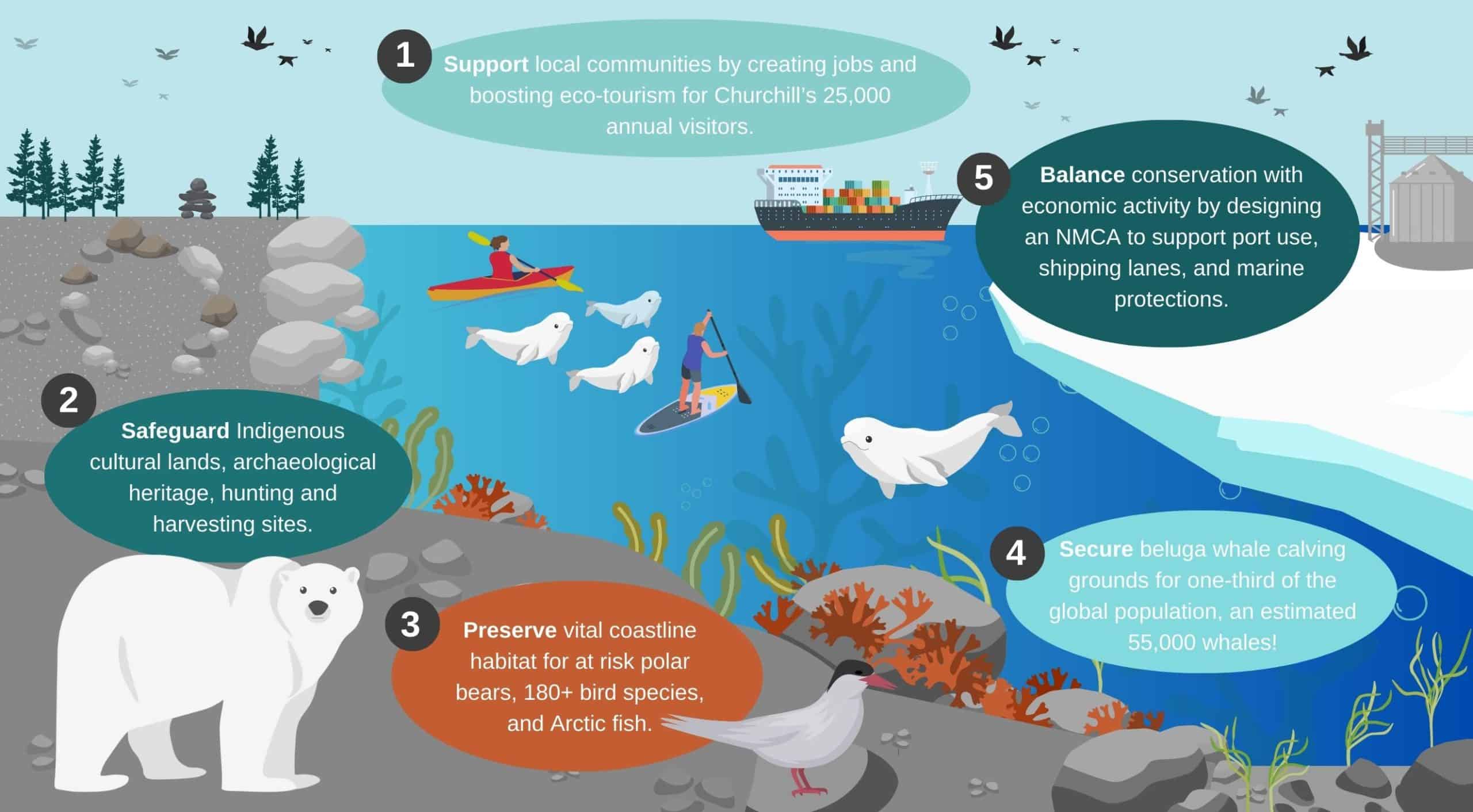
An NMCA for Hudson Bay could help maintain and enhance local livelihoods, and increase the region’s tourism industry amidst industrial changes. It could also create new jobs and bring infrastructure investments while maintaining safe, clean habitat for bears, belugas and birds.
Increasing industrial pressures could mean a future increase in pollution, animal-vehicle collisions as well as disruption to beluga’s underwater communication. An NMCA in Western Hudson Bay can provide businesses with greater certainty and predictability for long-term planning and operations. This can be done through clear guidance, rules, and designated shipping routes to reduce animal-vehicle interactions.
Marine protected areas are one of the most effective tools to restore balance, support livelihoods, and leave behind a thriving ocean for our children.
Healthy oceans, people, and economies don’t just happen on their own. They are the result of choices we make today. You can show your support for an NMCA by signing a postcard here!
Resources
Read the full report Widely Enjoyed but Inadequately Valued.
View the Oceans North report to learn more about why protecting the Western Hudson Bay region is critical for biodiversity and local communities.
Read more on the health benefits of being in Nature.
This blog was made possible through the generous support of the National Audubon Society. We’re grateful for their partnership, collaboration, and shared commitment to protecting the lands, waters, and wildlife we all cherish.
About CPAWS
CPAWS has been a national leader in marine protection for over 30 years. We work alongside Indigenous partners and local communities to advocate for stronger, better-connected marine protected areas that respect cultural values and protect ecosystems. Learn more about our national ocean protection work here.
About Western Hudson Bay
Western Hudson Bay is a crucial wildlife habitat, home to large populations of polar bears, beluga whales, and birds. CPAWS Manitoba is advocating for a National Marine Conservation Area (NMCA) to protect these species and their environment, while securing cherished regional cultures, ways of life for Indigenous peoples, and opportunities for sustainable livelihoods. NMCAs limit harmful activities like deep sea drilling and trawling, while allowing things like sustainable tourism and fishing. Establishing an NMCA in Hudson Bay would safeguard wildlife, protect local ways of life and promote long-term economic opportunities.